Meeting Automation: What to Automate and What Not To

Key Takeaways
- Meeting automation spans four stages: scheduling, preparation, capture during the call, follow-up, and sharing afterward.
- Capture sets the ceiling for everything after it. A meeting that was never recorded can't feed a CRM, a recap, or an AI agent.
- Follow-up is shifting from people to AI tools. Grain captures and enriches every meeting, then delivers it to Claude, ChatGPT, and the rest of the stack so agents can do the work.
- Sellers spend 60% of the sales week on activities other than selling, like admin work, according to Salesforce's 2026 State of Sales.
- Automation won't cut the meeting count, so judge any tool by the work it removes before and after each call.
What Meeting Automation Covers
Meeting automation is software that handles the administrative work around a meeting rather than the meeting itself. It books the time, preps the attendees, captures what's said, and moves the meeting outcomes wherever the work continues.
Meeting automation tools split along those four stages. Few products cover all of them well, so most teams assemble their meeting automation software from two or three tools, each owning a stage.
Scheduling is the one stage Grain doesn't cover yet. A booking tool like Calendly or Google Calendar handles it. Grain picks up once the call starts and owns what happens during it and after. Prep support is on the way as of publishing.
The follow-up stage is changing fastest. For years, follow-up meant a person reading an AI summary and deciding what to do with it. Now it increasingly means an AI tool reading the meeting itself and doing the post-meeting work: drafting the email, updating the deal, writing the brief.
Automate Capture: Joining, Recording, Transcription
Capture automation means every meeting gets recorded without anyone pressing a button. That used to be a convenience. Now it’s a prerequisite, because an AI tool can only work from a meeting that was captured.
Grain follows a rule set once in recording settings: auto-record external meetings, internal meetings, unscheduled calls, or any combination, as well as optionally only meetings the user organizes. The second option suits sales and customer success teams that want every customer conversation on file without recording internal one-on-ones. Grain joins whether or not the user is the host.
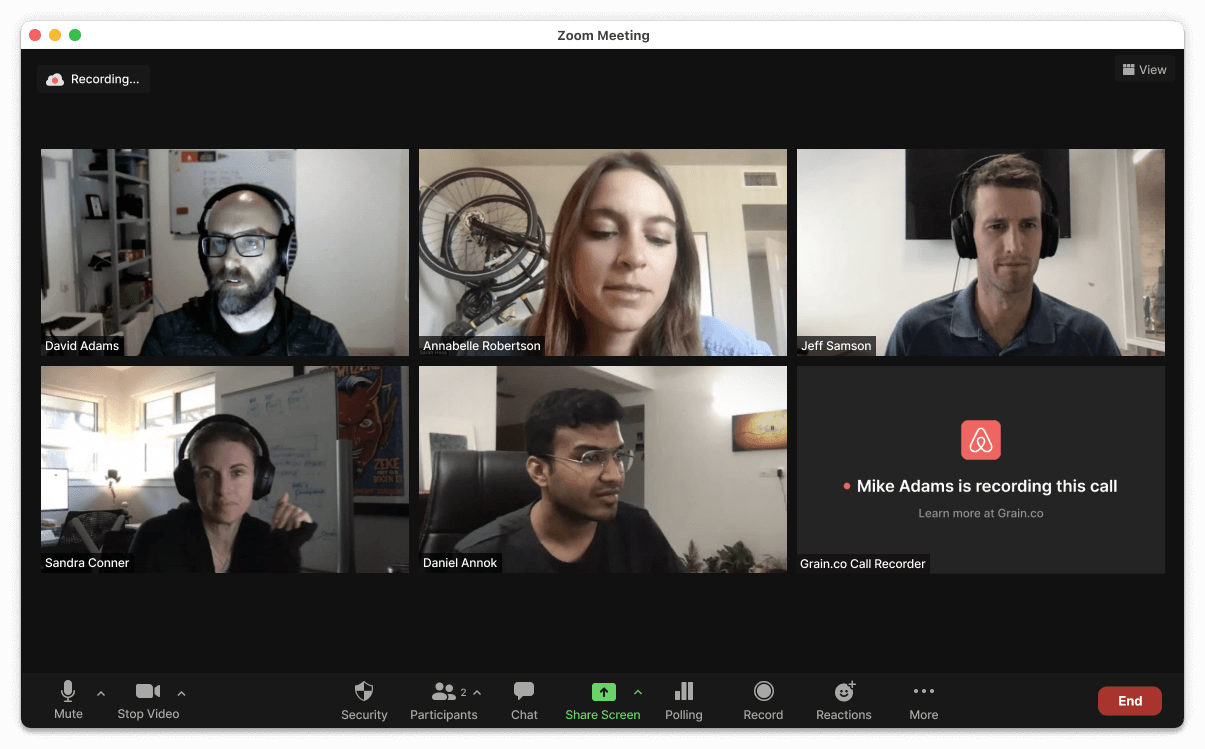
Calendar rules alone leave a gap. Microsoft's Work Trend Index telemetry found that among Microsoft 365's heaviest meeting users, more than half of meetings are ad hoc calls with no calendar invite. A notetaker that only joins scheduled events misses the quick "got five minutes?" call on Microsoft Teams. Grain records with a bot or without one, so capture doesn't depend on an existing invite, and the Grain mobile app, now in beta, covers calls away from the desk.
Capture quality matters too. A raw transcript is a wall of text. An enriched one knows who spoke and which company they're with, and that context lets an AI tool tell a prospect's objection from a colleague's aside. Grain enriches each meeting transcription before it goes anywhere, and every captured meeting adds to Grain’s memory so context carries across calls instead of starting over each time. Teams that record customer calls by default end up with a library an AI tool can actually use.
Automate Meeting Notes So Attention Stays on the Call
Manual note-taking splits attention during the call. A rep typing up a customer's objection misses the next sentence, and the next sentence is often where the real reason sits.
Attention is already scarce. Microsoft's research found the most-pinged Microsoft 365 users are interrupted roughly every two minutes during core hours by a meeting, email, or notification. A customer call is one of the few stretches of the day built for full focus, and spending it on transcription wastes it.
The second cost is sharper. Whoever takes the notes decides what the company remembers. Their reading of the call becomes the official record, and six weeks later nobody can check it against what the customer said.
AI tools make the gap worse. An agent drafting a follow-up from a rep's shorthand inherits every gap in it. Working from the full recording, it gets what summaries tend to drop:
- The objection in the customer's own words, before anyone softened it
- The condition attached to a yes, such as "yes, if legal signs off by Q3"
- Phrasing worth reusing in positioning, messaging, or the next call
Grain links each summary point and next step to its timestamp, so anyone who doubts a line can click through and hear it. People still taking notes on calls can keep a personal doc for their own thinking and leave the official record to the recording.

Automate the Handoff: Recaps, Channels, and AI Tools
Meeting insight reaches sales and operations workflows when meeting data flows into the tools those teams already use. For people, that's usually Slack. For the AI tools taking on more of the work, it's a direct connection to Claude or ChatGPT.
Slack recaps cover the people side. Grain posts automated meeting summaries to Slack by rule, filtered three ways:
- By meeting owner: every call a specific account executive hosts goes to that team's channel.
- By participant: any meeting with a named customer goes to that account's channel.
- By custom tag: calls tagged as a churn risk or feature request route to customer success or product.
Grain's own product and engineering team runs its daily standup this way:
- The team holds a short standup covering priorities, blockers, and dependencies.
- Grain records and transcribes the call, writes a summary, and extracts action items.
- The summary posts to the #daily-check-in channel as soon as the meeting ends.
- Any team member who missed it catches up and replies in thread on their own schedule.

Async catch-up matters more as teams spread out. Microsoft's telemetry shows roughly 30% of meetings now span more than one time zone, which means someone is always asleep during the standup.
A recap covers one meeting, and most of the useful questions span many. What has this account raised over its last three calls? Which objection came up most this quarter? Answering those by rereading recaps takes an afternoon. Grain's Claude connector and ChatGPT app let those tools search the meeting library, pull transcripts, and draw on Grain’s memory directly, so the answer comes back inside the conversation where the work is already happening.
Recordings shared into a Grain workspace build a searchable knowledge base for the team and its AI tools alike. PartnerHero took this route, and PartnerHero's meeting library now feeds how its team closes deals.

Automate the CRM Entry
The fastest way to stop re-entering meeting outcomes into a customer relationship management (CRM) system by hand is to let the meeting data write the record. When a call ends, Grain pushes the summary and key points into contact and deal notes. In HubSpot, it can also update any property using custom AI prompts, such as next step, competitor mentioned, or budget confirmed. The rep reviews the entry instead of typing it.

Ops and revenue leaders own the fix. Sales development reps (SDRs) and business development reps (BDRs), usually the most junior seats on a sales team, carry the heaviest logging load, which makes CRM entry the first place to look when improving SDR productivity with AI tools. It's also the easiest automation to justify, since the output lands in a system leadership already reports from.
Grain's CRM integrations sync notes to HubSpot, and Salesforce teams can log calls automatically the same way. One customer put a number on it:
"I save up to 25 minutes after every sales call as Grain automatically generates and adds the call notes in HubSpot for me."
Max Stoiber, Founder and CEO, Stellate
That's one founder's figure. The time saved depends on how many sales meetings a rep runs and how much detail the CRM requires.
Automate the Follow-Up Itself With AI Agents
An AI meeting agent for workflow automation reads meeting data and does the follow-up work a person used to do by hand. Instead of a rep turning a call into an email, a proposal, or a deal update, the agent drafts it from the recording and the rep reviews the result.
Sales teams are already moving this way. Salesforce also reports that 54% of sellers have used AI agents, and nearly nine in ten plan to by 2027. Once agents are fully in place, sellers expect them to cut prospect research time by 34% and email drafting by 36%.
Agents are only as good as the meeting data they read. In the same survey, 51% of sales leaders with AI say disconnected systems are slowing their AI initiatives. An agent that sees one meeting, or a library with holes in it, produces thin work. Before connecting an agent to meeting data, check three things:
- Coverage: every meeting is captured, including the ones with no invite.
- Context: transcripts carry speaker and company details, so the agent knows who said what.
- Access: admins control which meetings an agent can see, so a customer call doesn't surface in the wrong place.
Grain's meeting workflows follow that checklist: every meeting captured and enriched, then passed to the AI tools a team already uses.
What Meeting Automation Does Not Fix
Automation clears the admin. The problems inside the call stay put, and agents can amplify them.
- The meeting count. No stage of automation removes a meeting from the calendar. A clearer recap can make a follow-up meeting unnecessary, but a person still makes that call.
- Decisions nobody made. A clean recap of an inconclusive call is still an inconclusive call, and an agent can't draft a next step nobody agreed to.
- Ownership of the record. Someone still has to read and correct what automation writes. That matters more once agents act on it, because an error in a CRM note becomes an error in every email drafted from it. According to Salesforce, 74% of sales professionals are focused on data cleansing, and automated entries don't exempt a team from that work.
- Gaps between tools. Scheduling and capture usually come from separate vendors, whatever a category page promises. Write down which stages a tool actually owns before budgeting for the rest.
Why a Captured Meeting Library Gets More Valuable
The minutes saved per call add up, but the bigger payoff is the record itself. Every captured meeting adds to a history of what customers asked for, what the team decided, and why, and that history gets more valuable each time an AI tool reads it. Per Salesforce, 87% of sales organizations already use some form of AI, so the readers are already in place.
A large library also shows what no single call can: the objections that keep coming up, how top reps handle them, and where the team needs coaching. An AI tool can pull those patterns from a quarter’s worth of calls in minutes.
Grain sits at that layer, so the record exists before any agent needs it. By Grain's own usage data, 97% of teams are still on Grain after 12 months. Teams deciding where to start can compare Grain's plans.
Frequently Asked Questions
Can ChatGPT Do Meeting Minutes?
Yes. ChatGPT can turn a pasted transcript into minutes, and its Record mode, available in the Mac desktop app on paid plans, can capture a meeting once someone starts the recording. Teams that already capture every call in Grain can skip both steps, since Grain's ChatGPT app gives ChatGPT direct access to recorded meetings.
What Is the Difference Between a Meeting Transcript and a Meeting Summary?
The full transcript is the record of what everyone said. A summary is a selection from it, made by a person or a model. AI tools do better work from the transcript, because a summary can't return what it left out.
What Is MCP for Meetings?
MCP stands for Model Context Protocol, an open standard that lets AI tools such as Claude and ChatGPT connect to outside data sources. MCP for meetings means an AI tool can pull recorded meetings in as context without anyone copying and pasting meeting transcripts. Grain offers this through its Claude and ChatGPT connectors.
Does Office 365 Have Meeting Scheduling Built In?
Yes. Outlook's Scheduling Assistant shows attendee availability, and Microsoft Bookings, including the personal Bookings with me page, lets people book time against an Outlook calendar. The Scheduling Assistant only reads calendars inside the organization, so meetings with outside guests run through Bookings or a dedicated scheduling tool.
If Notes Are Automated, Does Anyone Still Need to Attend?
Yes, whenever the meeting needs their input. Automated notes answer who keeps the record, and attendance is a separate question about who takes part. A recording can't ask the follow-up question in the moment, and that question is often why the meeting was worth holding.

.png)